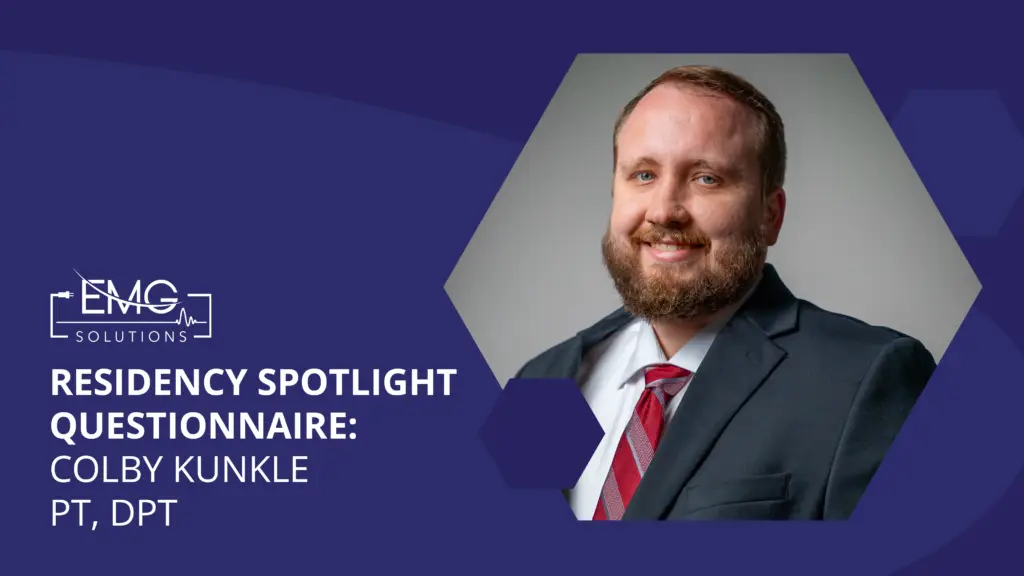
Where did you receive your DPT degree, and what led you to the PT profession?
I received my degree from the University of Alabama at Birmingham. Growing up, my dad worked as a podiatrist at UAB, so I have fond memories of him taking me to UAB football, basketball, and soccer games as a child. Each year, my dad was asked to give a guest lecture to the UAB DPT students on the foot and ankle as part of their orthopedic class. He became good friends with Dr. Perez over there, and that is how I was introduced to physical therapy. I investigated the profession more over time, prayed about it, and ultimately felt that it was a good fit for me. I loved my PT school experience and am excited to be a part of the profession!
When did you first learn about clinical electrophysiology offered as a specialty for Physical Therapists?
I first learned about electrophysiology in the first semester of PT school. One of my professors was sharing a little bit about each of the specialties. He didn’t have much experience with electrophysiologists, but he said something about them traveling around with their computers, doing this mysterious thing called nerve testing. Well, what he said got me curious, so I started looking into it and thought it sounded interesting.
At what point did you become interested in EMG and NCSs?
I became seriously interested in EMG/NCS in my third semester of school. During our modalities class, we did a short section on electrophysiology, and I loved it. I’ve always been a little bit nerdy, so I was drawn in by the technicality, physiology, and anatomy involved in the testing. From there, I was fortunate to have a few of my professors share with EMG Solutions that I was interested in electrophysiology. This allowed me to shadow some clinicians and then progress to doing one of my clinical rotations with EMG Solutions. Needless to say, I’m very grateful to be a resident here and to be participating with so many fine clinicians in a very fascinating and exciting area of PT practice.
What made you decide to go the Residency route vs. independently completing study and earning mentor hours?
I decided to pursue the residency route primarily because I loved my clinical experience here and knew this was an area of practice I wanted to participate in. Additionally, from that experience, I knew that there was no other place in the country I could go that would prepare me more thoroughly for the ECS examination and allow me to be able to perform 2,000+ studies in a little over a year. If you’re serious about learning how to perform EMG and NCS, this is the best place to be!
What have you loved most about the residency?
I have loved the one-on-one opportunities to learn from multiple mentors that the residency provides. It is so beneficial to be able to work with mentors who are so accessible and so willing to help me grow as a clinician. Additionally, it is great to learn from a variety of mentors as each one’s unique view and way of practicing ultimately informs my practice and makes me a better clinician. I have found the amount of collective experience here at EMG Solutions to be incredibly beneficial to my growth as an electromyographer.
Is there anything you have disliked about the residency?
While it is a great benefit to work with different mentors, it can also be challenging to match each one’s testing practices and report preferences. There can be a little inconsistency between the expectations and requirements of each mentor, which can be frustrating at times.
What is the most interesting case you have tested, and what did you learn?
About a week or two into my residency, Austin and I performed a study on a patient with an anterior interosseous nerve injury. Throughout his history, his primary complaint was that he was dropping his phone frequently, with his thumb slipping while holding it. We asked him to perform an “OK” sign, which he was unable to do. This led to testing the anterior interosseous nerve, which we found to be compromised. We also found a median nerve compromise at the wrist. However, had we not listened carefully to his history and added to our clinical examination, we may have missed the AIN injury and attributed his symptoms to carpal tunnel syndrome only. This experience taught me the importance of a thorough, yet efficient, patient history and clinical examination, and how it informs good EDX testing.
What words of advice would you like to share with potential or future residents?
If you feel drawn to electrophysiology, apply to the residency. Come join us. Get ready to work and reap the rewards. If you are a recent graduate and are worried about not having enough clinic experience before becoming a resident, know that you will gain plenty of experience here. You will see a variety of patients, and you will grow as an overall clinician, not just as an electrophysiologist. Additionally, there are many ways to maintain and continue to hone skills for other areas of practice while being a resident. PRN work on the weekends is great for further developing other clinical skills. Also, many of the mentors and other residents practiced in other areas before focusing on EMG. They are happy to practice other techniques and share that knowledge as well.
Has the residency met your expectations? How?
The residency has definitely met my expectations. I am very happy with the training I am receiving, and I eagerly look forward to improving each day. I feel that I am growing as a physical therapist and as a person. I have the utmost confidence that the residency will prepare me for the ECS exam, and I feel that I am well on my way toward reaching my goal of becoming an ECS physical therapist.
Is there anything else you would like to share with potential residents or those considering the EMG Solutions Residency?
If you are interested in clinical electrophysiology, go for it. There is a need for more electromyographers. This residency provides a great experience that will not only train you in EDX testing but will also serve to improve your practice as a clinician in other settings. Come and be a part of this great group. Become one of the relatively few ECS physical therapists in the country and be ready to grow as a clinician!
To learn more about EMG Solutions’ Clinical Electrophysiology Residency or to explore student clinical rotation opportunities, visit emgsolutions.com.
This blog is a feature from Edition 6 of our newsletter, which you can find here.