
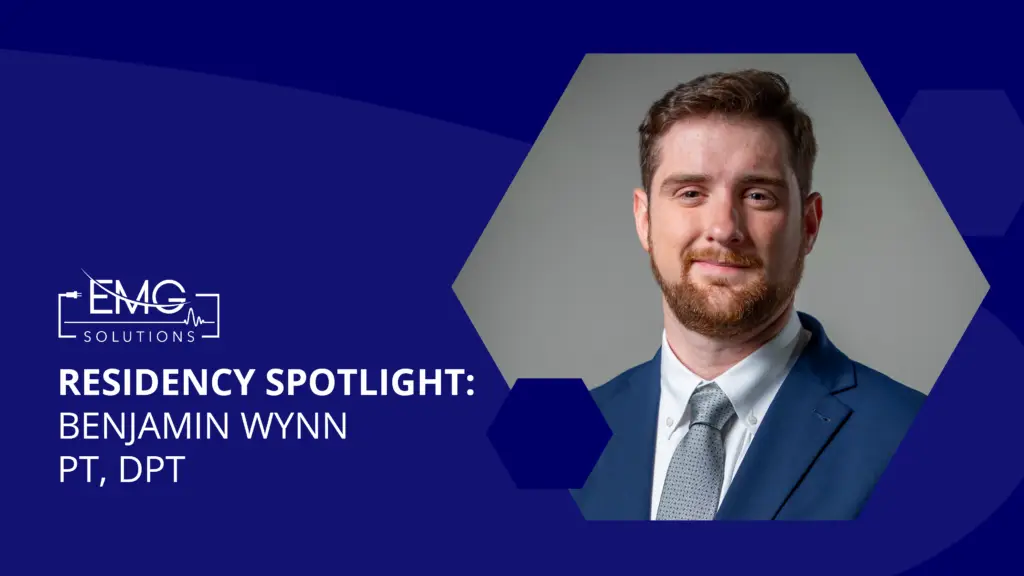
Where did you receive your DPT degree, and what led you to the PT profession?
I received my DPT from Mercer University in Atlanta, GA, in May 2025. I have many reasons why I chose physical therapy. The number one reason is that it is a profession in which you get a lot of one-on-one time with patients, where you can influence their health and make sure they feel seen and cared for in every encounter. Additionally, it is a profession that challenges you to learn and improve continually. There is always room to improve and better yourself for your patients in this field.
When did you first learn about clinical electrophysiology offered as a specialty for Physical Therapists, and at what point did you decide EMG was the direction you wanted to take your career?
I knew I wanted to advance my skills beyond my DPT degree, and so I looked into all specialties of physical therapy. Then I stumbled across ACEWM on the APTA site and thought EMG looked interesting. EMG Solutions then presented to my cohort during a job fair and offered observation days. So, I set up days to observe and loved it.
What made you decide to go the Residency route vs. independently completing study and earning mentor hours?
The residency through our company seemed like the most efficient way to learn the skills and meet the requirements for boards. I also know that I need a more structured learning environment and mentoring to be successful, and this company offers that.
What have you loved most about the residency?
I love the variety and complexity of the patient cases. There is rarely a day that I do not learn or see something new. Each patient has a unique presentation and story, and it is our job to sort the pieces of the puzzle. There is never a boring day in EMG.
Is there anything you have disliked about the residency?
A point of difficulty for me has been switching between mentors as frequently as I have. It is overall a good thing because I get to experience many different styles and learn what I do and do not like. However, it is difficult at times to switch between what each mentor prefers.
What is the most interesting case you have tested so far, and what did you learn?
We had a baseball player who damaged a small sensory nerve in his hand because he held the knob of the bat in his hand when batting. This was a unique case because the nerve that was damaged is rarely the only one involved, so testing had to be very specific. My mentor had never done a study on that specific spot before, but was able to put a test together and isolate the point of compromise effectively. It was a cool moment where I thought, “I can’t wait to be that good at this.” It really showed how being an expert in anatomy and highly skilled in electrodiagnostics can be so useful for patients and Physicians.
What words of advice would you like to share with potential or future residents?
This is a very rewarding and challenging setting. You will have great days/weeks where you feel that you are performing well, and then you will have tough days/weeks. It is important to understand that it is a process and not to get down on yourself during the tough weeks. Also, this company is very tight-knit, so reaching out to mentors/colleagues will be your greatest resource during the tough days/weeks.
Has the residency met your expectations? How? It has met and exceeded expectations. I enjoy going to work each day and having a new challenge and opportunity to learn and improve. This residency has given me that each day, and through strong mentorship, I have rarely felt completely overwhelmed.
Is there anything else you would like to share with potential residents or those considering the EMG Solutions Residency?
Definitely set up observation days if you have not yet. I believe it gives you the best idea of what we do and if you’re a good fit for this setting.
This blog is a feature from Edition 9 of our newsletter, which you can find here.