
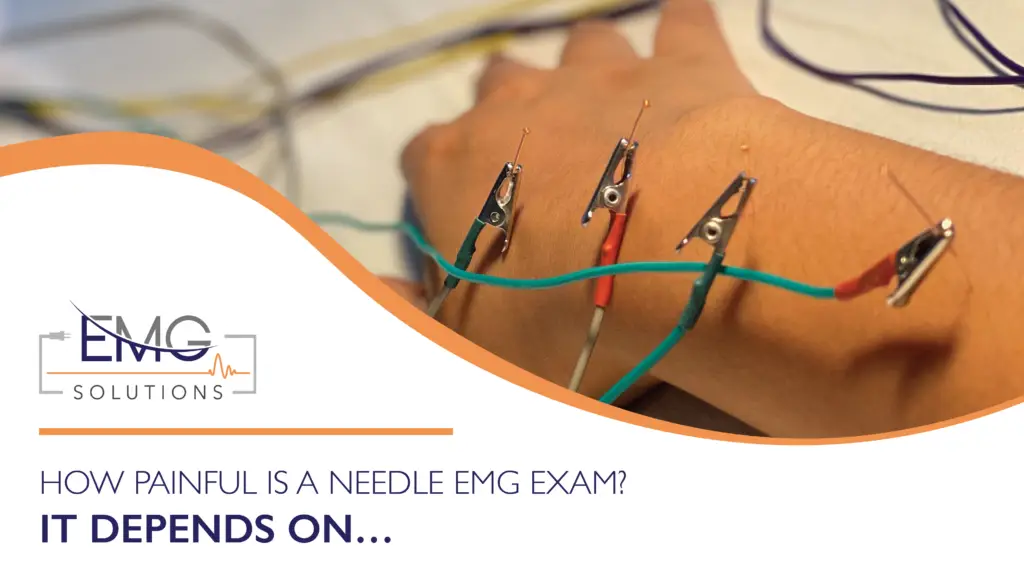
By John Lugo, PT DPT, Program Coordinator, EMG Solutions Residency Program, Site Coordinator of Clinical Education, EMG Solutions
This blog post is intended for anyone who has been recommended to have a needle EMG exam that is part of a “nerve test”. The information contained can also be helpful for health care professionals who recommend that their patients have an electrodiagnostic examination.
I have been performing needle electromyography (EMG) exams for over 20 years. I have encountered many types of people throughout the country, from corporate executives in midtown Manhattan to undocumented laborers in Brooklyn and Queens, to farm workers in rural areas of Pennsylvania and Alabama. Across people of all backgrounds, the most common question people ask me after I explain the procedure is “How much is this going to hurt?” The goal of this article is to address this concern.
Diagnostic tests are a common part of health care. X-rays, CT scans, MRIs, and ultrasounds give providers information about the body’s internal structure. Blood and urine tests reveal clues about the function of internal organ systems. Needle EMG exams are performed to describe the working status of a person’s nerves and muscles. Of the above-mentioned tests, needle EMG exams are probably the least commonly performed but also likely cause the most anxiety about the actual procedure of the test. This is presumably due to the use of the needle.
Needle phobia is a very real condition that is listed in the American Medical Association’s tenth revision of the International Classification of Diseases. It is estimated that 2 in 3 children and 1 in 4 adults have strong fears around needles. I recall that when I was a small child, I dreaded going to the doctor and was told by my parents that it sometimes took multiple people to stabilize my arm or leg when I would get a needle injection of medication or vaccine. Even people without a fear avoid procedures using needles because they do not want the discomfort associated with needles. Before I discuss some things that have been done to address the concern, I’ll explain the use of the needle in diagnostic EMG tests.
Needle EMG tests examine the electrical signals produced by our nerves and muscles. These biological types of electrical signals have much less voltage than those in machines. During a strong contraction, a group of muscle fibers will normally have a voltage one million times smaller than a nine-volt battery. A very precise instrument is needed to observe signals that small. While some of the voltage can be detected through the skin, the skin itself dampens the signal that can be recorded. So, to get the best measurement of the body’s electricity, the detection device needs to be inside the muscle. Unlike needles that deliver medication or withdraw fluid, the needles used in EMG tests have a very fine wire that is designed to detect the small electrical signal of the muscle. The proper amount of electrical voltage is needed in our body’s nerves and muscles to allow us to feel things and to move our bodies to do tasks. Even a slightly lower amount of electricity than normal can be discovered in conditions like carpal tunnel syndrome, sciatica, and amyotrophic lateral sclerosis, also known as Lou Gehrig’s disease. Being able to detect all of the electricity available is important to making the right conclusion.
Other differences between the use of needles in EMG and the use of needles in delivering medication or withdrawing fluid include the size of the needle and how the needle is inserted into the body. Needles used in EMG are relatively much thinner than needles used to draw blood. A needle’s gauge is the measurement of the size of the diameter (how big around) of the needle, with a higher number indicating a smaller diameter. The range of needle gauges used in needle EMG is 26 to 31 gauge, while needles used in intramuscular injections are 22-25 gauge, and the most common type of needle to do a routine blood draw is 21. Unfortunately, with needle EMG, because the size of the needle is so small, it needs to be moved inside the muscle to measure a sufficient area of the muscle. This movement can be associated with more discomfort. Needles for injection or fluid draw are stationary after entering the body. Lastly, during an EMG exam, you do have to tighten the muscle to measure the electrical activity of the muscle when it is contracting.
Healthcare providers like myself who perform needle EMG tests are aware of the discomfort of the exam. There have been papers published in journals suggesting ways to help reduce the discomfort. Buckelew and colleagues stated in 1992 that teaching active self-control skills and increasing patients’ self-efficacy beliefs can help manage the anxiety and pain associated with needle EMG exams. They also noted that reinterpreting the patient’s pain and judging the patient for their anxiety leads to more discomfort. Strommen and Daube in 2001 discovered that the type of needle movement by the provider plays a large role in the type of pain reported by the patient. Small, straight movements of the needle are recommended.
Stepping away from the healthcare and needle conversation for a moment, some people prefer to know when something unpleasant is about to happen so they can better prepare themselves. A theory for this rationale is that the bad event is less bad if they are ready for it. This thinking has been applied to the performance of needle EMG. A study from Australia in 2018 showed that female patients who received written information about the procedure reported significantly lower perceptions of pain from the EMG exam compared to those who got no information.
Unfortunately, a previous study from Italy in 2014 showed that a majority of patients received no information or poor/incorrect information prior to the test. There are also recommendations on how to reduce discomfort beyond educating the person getting the test or ways to move the needle. Tapping or stretching the skin near the needle insertion site have been shown to be helpful. Providing distractions such as videos, doing breathing exercises, and devices that vibrate the skin can also be used. Lastly, numbing creams and sprays or oral medications for sedation and pain relief can be considered. However, the side effects of oral medications and the risk of infection from the skin numbing agent entering the body along with the needle need to be carefully considered.
Pain is something that is very difficult to measure and compare from person to person, so it will be difficult to say how much the needle EMG will be perceived as painful for each person. In professional sports, some athletes will miss field time from a blister, while others can play with near-broken bones. Some people will seek out invasive procedures like tattoos or piercings, while others will be more reserved. There are strategies that providers can use to help minimize the discomfort, and things a person can do to mitigate or distract from the experience. There are also things healthcare providers can do to make the experience more uncomfortable.
In my own interactions with patients, I’ve been told by some people that the way I do the test is much more comfortable than the test they had from another provider, or wasn’t as bad as they thought it was going to be. I’ve also been asked not to return to some clinics because people have stated the test was uncomfortable. The act of inserting a needle into the body is going to be uncomfortable. If you know that you do not deal with discomfort well, you should try to take extra steps to mitigate the discomfort, including seeking out a provider who demonstrates compassion and discussing your concerns with the person doing the procedure. If you and your referring provider agree that the information from the test will help you, then mentally accepting temporary discomfort of the test might provide extremely useful information. To answer the question in the title of this article, many things can influence how much discomfort you experience during a needle EMG exam, including how you personally experience pain.
References
- Needle phobia diagnosis code:https://www.icd10data.com/ICD10CM/Codes/F01-F99/F40-
F48/F40-/F40.231. - Needle fears and phobias: https://www.cdc.gov/childrensmentalhealth/features/needle-
fears-and-phobia.html. - Gauges of needles in EMG: https://www.ambu.com/Files/Images/ambu/clinical-
studies/Neuroline_EMG_Needles/Concentric-and-Monopolar-electromyographic-1211.pdf. - Buckelew, S. P., Conway, R. C., Shutty, M. S., Lawrence, J. A., Grafing, M. R., Anderson, S. K.,
Hewett, J. E., & Keefe, F. J. (1992). Spontaneous coping strategies to manage acute pain and
anxiety during electrodiagnostic studies. Archives of Physical Medicine and Rehabilitation,
73(6), 594–598. - Strommen, J. A., & Daube, J. R. (2001). Determinants of pain in needle electromyography.
Clinical neurophysiology: official journal of the International Federation of Clinical
Neurophysiology, 112(8), 1414–1418. https://doi.org/10.1016/s1388-2457(01)00552-1. - Lai, Y. L., Van Heuven, A., Borire, A., Kandula, T., Colebatch, J. G., Krishnan, A. V., & Huynh,
W. (2018). The provision of written information and its effect on levels of pain and anxiety
during electrodiagnostic studies: A randomised controlled trial. PloS one, 13(5), e0196917.
https://doi.org/10.1371/journal.pone.0196917. - Mondelli, M., Aretini, A., & Greco, G. (2014). Knowledge of electromyography (EMG) in
patients undergoing EMG examinations. Functional neurology, 29(3), 195–200. - London Z. N. (2017). Safety and pain in electrodiagnostic studies. Muscle & nerve, 55(2),
149–159. https://doi.org/10.1002/mus.25421.