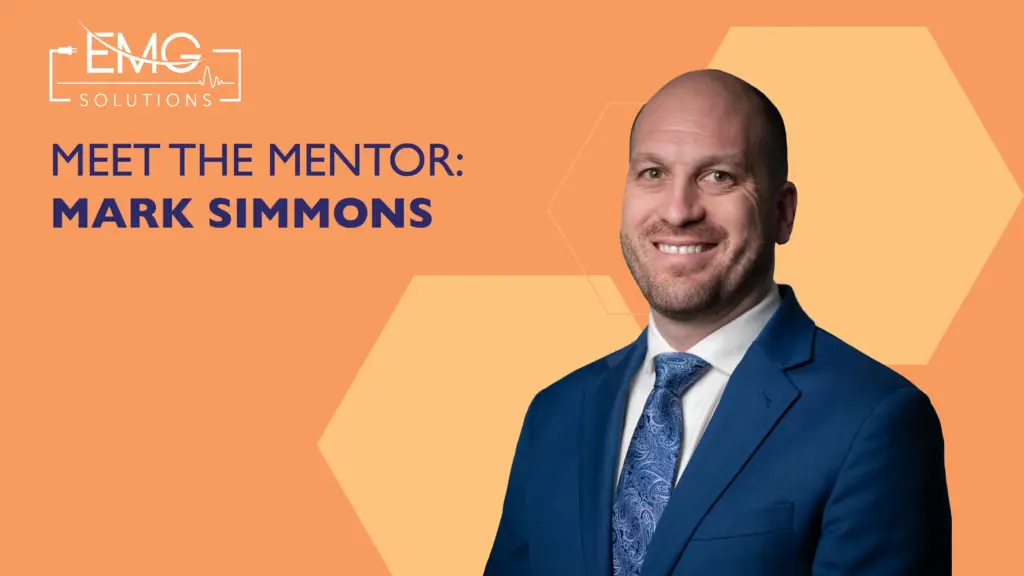
How did you become interested in electrodiagnostic testing?
During physical therapy school, we had a brief introduction to the specialty by a guest lecturer. This lecture was placed early in the program curriculum, just after completing our Neuroscience class. The therapist came and did two 1-hour lectures, and I recall leaving the last lecture thinking, “Who the heck would want to do that?! It makes no sense!” Fast forward 1-2 years to the start of our clinical rotations. At our school, we had the ability to try to request new clinical sites, and I was fortunate to do just that. My father worked as a hospital administrator in Philadelphia, PA, and I was able to set up an inpatient rotation.
During my time in PT school, the thought of electrodiagnostic testing stayed on my mind. I knew that I wanted to find a niche area and not become one of the masses of PTs. Due to my interest in electrodiagnostic testing, my father set up a meeting with the head of neurology to discuss the possibility of doing some training under her. Unfortunately, she had requirements and duties to the Residents and Fellows of the medical school attached to the hospital, but she did get me in touch with Rick Read, PT, DSc, ECS, who performed all the EMG/NCV testing for the Philadelphia Hand Center. I was given the ‘ok’ from my CI to shadow Dr. Read for 3 days. These 3 days were challenging. We did a lot of traveling between clinics in DE and PA, but during our car rides, Dr. Read would quiz me on everything. I came out of the experience knowing that Clinical Electrophysiology was the specialty I wanted to pursue.
What was your learning process to become certified in clinical electrophysiology? How long did it take you to complete the ECS?
After graduating from physical therapy school, I accepted an outpatient physical therapist position with the North Little Rock Veterans Affairs Hospital. At that time, there were really only 3 options to become trained in Clinical Electrophysiology. 1) Find a mentor who is willing to train you, which was difficult due to the small number of ECS PTs, plus I needed a paycheck, so finding someone to pay me and train me was impossible. 2) Join the military and request to be trained in EMG, or 3) Attend Rocky Mountain University Basic and Intermediate EMG courses, but this option did not provide mentorship. I chose option 3 and attended the basic course.
It was during my time at RMU that I was given the contact information for Quinn Millington, DPT, ECS, OCS. Dr. Millington was the founder of EMG Solutions and was looking to mentor someone. After spending 16 years in Arkansas, I left for central Alabama and joined Dr. Millington and EMG Solutions. Over the next year, Dr. Millington instilled his 20 years of knowledge of the specialty into me, showing me the best books to study. After 1-2 years of hard work, I was able to successfully pass the ABPTS ECS examination. Looking back at my educational journey, I am eternally grateful for the time and energy that Dr. Millington poured into me, but also envious that new physical therapists have the opportunity to join a residency program.
How many years of experience do you have as an ECS Physical Therapist?
As of September 2025, I have started my 14th year with Dr. Millington and EMG Solutions. Together with Dr. Millington and Dr. Darin White, PT, DPT, ECS, we created the ABPTRFE-accredited EMG Solutions Residency in Clinical Electrophysiology, and I currently serve as the Residency Director.
What do you love most about this specialty practice?
I love the autonomy you have on a daily basis and the relationship you develop with your referral sources. It is stressful knowing that the surgeons who send you patients are making surgical decisions based on your findings. I love that I have the ability to work with multiple clinics and multiple doctors throughout multiple states. I also really enjoy watching my residents and students grow into independent board-certified clinical electromyographers.
If there is one thing that you would change within the specialty of EDX, what would that be?
I am not sure I have anything specifically I would want to change. Sure, every field has its small issues, but Clinical Electrophysiology is such a unique animal that it’s very hard to compare it to the other specialties. Those with ECS board certification are highly trained individuals whose reimbursement depends on their board certification, and we are the only specialty in the world of PT in which this is required.
Do you see Physical Therapists specializing in EDX as a growing need?
Absolutely, while being, I believe, the oldest specialty, it is still one of the smallest. We only have 269 board-certified individuals. We need more ECSers to join the ranks. The demand for trained individuals has exponentially grown since the start of my ECS journey.
What would be your words of advice/wisdom/inspiration to PTs who are interested in becoming certified in clinical electrophysiology?
Go for it! ECS is a challenging feat to obtain, but it is so incredibly rewarding! You need to be somewhat of a nerd at heart to love EMG!
Any additional thoughts or comments?
Have to include my shameless plug for the EMG Solutions’ Residency in Clinical Electrophysiology. I am incredibly proud of what Dr. Millington, Dr. White, and I created. The family we have here at EMG Solutions is amazing, and the success we have had with our Residency program would not be possible without each individual who makes up that family!
This blog is a feature from Edition 8 of our newsletter, which you can find here.