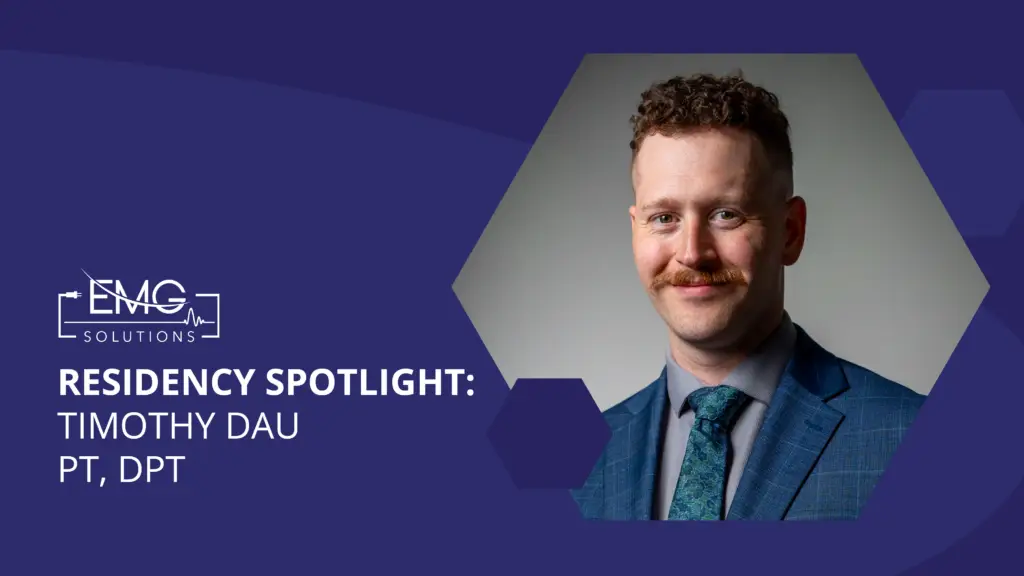
Timothy Dau, PT, DPT, completed his clinical electrophysiology residency with the EMG Solutions Residency Program and shared valuable insights in what he learned.
Where did you receive your DPT degree, and what led you to the PT profession?
I received my DPT at Rocky Mountain University of Health Professions in Provo, Utah. I came to the PT profession because I have a passion for how the human body works. I love anatomy and physiology.
When did you first learn about clinical electrophysiology offered as a specialty for Physical Therapists, and at what point did you decide EMG was the direction you wanted to take your career?
I learned about the specialty while in physical therapy school. Dr. Richard P Nielsen came and presented about electrodiagnostic testing in our first semester of PT school. I was fascinated by it and decided to shadow him throughout my time at RMU. That led to doing a student rotation with EMG solutions, and the rest is history.
What made you decide to go the Residency route vs. independently completing study and earning mentor hours?
Since I was a student with EMG Solutions, I got to see firsthand what the mentorship looked like within the residency program. I think the volume of studies we can do, as well as the consistent feedback from mentors, is what led me to choose this path. I think it is the fastest way to become an expert in the specialty.
What have you loved most about the residency?
I enjoy the mentorship. There are so many smart minds in our company, and bouncing ideas back and forth with people is a great way to learn.
Is there anything you have disliked about the residency?
I dislike the timing of not being able to take the ECS exam this upcoming spring or even in the fall, but that is not the fault of the residency. Just poor timing. Sometimes I think I should have had more time before I was fully independent, but I also value the “figuring it out” that is required when you are on your own.
What is the most interesting case you have tested so far, and what did you learn?
I had a day recently that had two of the most interesting cases I have seen so far. The first was polyneuropathy that had really complex EMG findings and potentially a motor neuron disease. The second case was a patient who had an incomplete spinal cord injury, and he had a lot of difficulty with activating certain muscles. With both, I learned that there is not a whole lot in electrodiagnostic testing that is black and white; you have to read between the lines often and best interpret the data you can collect.
What words of advice would you like to share with potential or future residents?
I would say keep learning, stay humble about what you know. There is a vast amount of information to learn, and that is not going to stop with the residency. Keep learning.
Has the residency met your expectations? How?
The residency is about what I expected. I think I became a little faster than what I was comfortable with initially, but I also kind of expected that to happen. I think the caseload that I have in Asheville has a lot more pathology than I encountered in Huntsville, which was surprising, but I am excited to gain more experience with complex patients and continue learning.
Is there anything else you would like to share with potential residents or those considering the EMG Solutions Residency?
I would say it is important to dive right in and learn as much as you can. It is overwhelming at first, but you start to get the hang of it. I am still learning, so it feels weird to give advice at this point, but just keep on getting after it.
This blog is a feature from Edition 8 of our newsletter, which you can find here.
Visit Clinical Electrophysiology Residency program to learn more about all that it has to offer.