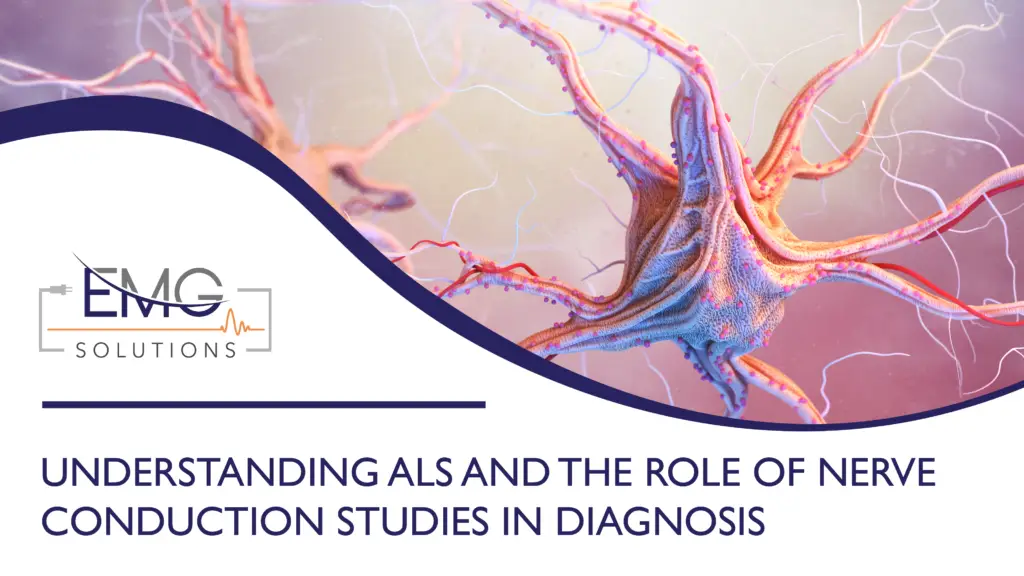
Amyotrophic lateral sclerosis (ALS) is a neurodegenerative disease that affects motor neuron nerve cells that are responsible for controlling voluntary muscle movement. As these motor neurons deteriorate and die, the muscles they control begin to weaken, twitch, and eventually waste away (atrophy) due to loss of nerve input. ALS is progressive, meaning symptoms worsen over time. The rate of progression varies from person to person, but on average, the life expectancy is 2 to 5 years after diagnosis.
Diagnosing ALS can be complex, requiring a combination of clinical evaluation and specialized diagnostic tests, which include nerve conduction studies (NCS) and electromyography (EMG).
What is ALS?
ALS is a motor neuron disease characterized by the gradual degeneration of upper motor neurons (in the brain) and lower motor neurons (in the brainstem and spinal cord). While its exact cause remains unknown in most cases, it is sporadic in about 5–10% are familial, linked to genetic mutations.
Symptoms of ALS include:
- Progressive muscle weakness (starting in the limbs, bulbar muscles, or respiratory muscles)
- Fasciculations (muscle twitching)
- Muscle cramps
- Spasticity (stiff muscles)
- Slurred speech and difficulty swallowing (bulbar symptoms)
- Respiratory difficulties in advanced stages
How is ALS Diagnosed?
There is no single test for ALS. Instead, diagnosis is made based on a combination of clinical symptoms, exclusion of other conditions, and the use of electrodiagnostic tests like electromyography (EMG) and nerve conduction studies (NCS).
What can an Electromyography Study Show?
Electromyography (EMG) records the electrical activity of muscles at rest and during voluntary movement using a small needle electrode inserted into various muscles. EMG is a key diagnostic tool in evaluating patients suspected of having amyotrophic lateral sclerosis (ALS) by recording the muscle wasting that is typically seen in the muscles of many limbs and the face.
What can a Nerve Conduction Study Show?
Nerve conduction studies can assist by measuring how quickly and effectively electrical signals travel along a nerve using small electrical impulses. The resulting activity is recorded using surface electrodes, and this helps to evaluate both motor and sensory nerves.
Although ALS primarily affects motor neurons, NCS is used to differentiate ALS from other neuromuscular disorders.
- Normal sensory nerve conduction: With ALS, sensory nerves are typically unaffected.
- Normal or slightly reduced motor nerve conduction velocity: ALS affects the motor neurons, but the nerves themselves often remain intact early on.
- Exclusion of other conditions: NCS helps rule out disorders such as:
- Peripheral neuropathy (which would show reduced sensory responses)
- Multifocal motor neuropathy (may show conduction block)
- Myasthenia gravis
- Spinal cord lesions
In ALS, the absence of sensory nerve involvement on NCS supports the diagnosis, but definitive signs are found on EMG, which detects spontaneous muscle activity, fibrillations, and fasciculations indicative of motor neuron loss.
Overall, ALS is a challenging disease to diagnose and is particularly difficult in its early stages when symptoms may be subtle. Nerve conduction studies play an essential role in the diagnostic process by helping to rule out other conditions and contribute to a more accurate and timely diagnosis, allowing patients to access care and support earlier in the course of the disease.
Bibliography
Brown, R. H., & Al-Chalabi, A. (2017). Amyotrophic Lateral Sclerosis. New England Journal of Medicine, 377(2), 162–172. https://doi.org/10.1056/NEJMra1603471.
Miller, R. G., Jackson, C. E., Kasarskis, E. J., et al. (2009). Practice Parameter update: The care of the patient with amyotrophic lateral sclerosis: Multidisciplinary care, symptom management, and cognitive/behavioral impairment (an evidence-based review): Report of the Quality Standards Subcommittee of the American Academy of Neurology. Neurology, 73(15), 1227–1233. https://doi.org/10.1212/WNL.0b013e3181bc01a4.
Preston, D. C., & Shapiro, B. E. (2021). Electromyography and Neuromuscular Disorders: Clinical-Electrophysiologic Correlations (4th ed.). Elsevier.
De Carvalho, M., Dengler, R., Eisen, A., et al. (2008). Electrodiagnostic criteria for diagnosis of ALS. Clinical Neurophysiology, 119(3), 497–503. https://doi.org/10.1016/j.clinph.2007.09.143.
Statland, J. M., Barohn, R. J., & Katz, J. S. (2007). Diagnosis of amyotrophic lateral sclerosis and other motor neuron disorders. Current Opinion in Neurology, 20(5), 564–567. https://doi.org/10.1097/WCO.0b013e3282eebcf6.
National Institute of Neurological Disorders and Stroke (NINDS). (2023). Amyotrophic Lateral Sclerosis (ALS) Fact Sheet. Retrieved from https://www.ninds.nih.gov/.
The ALS Association. (n.d.). The ALS Association. Retrieved [September 30th, 2025], from https://www.als.org/.