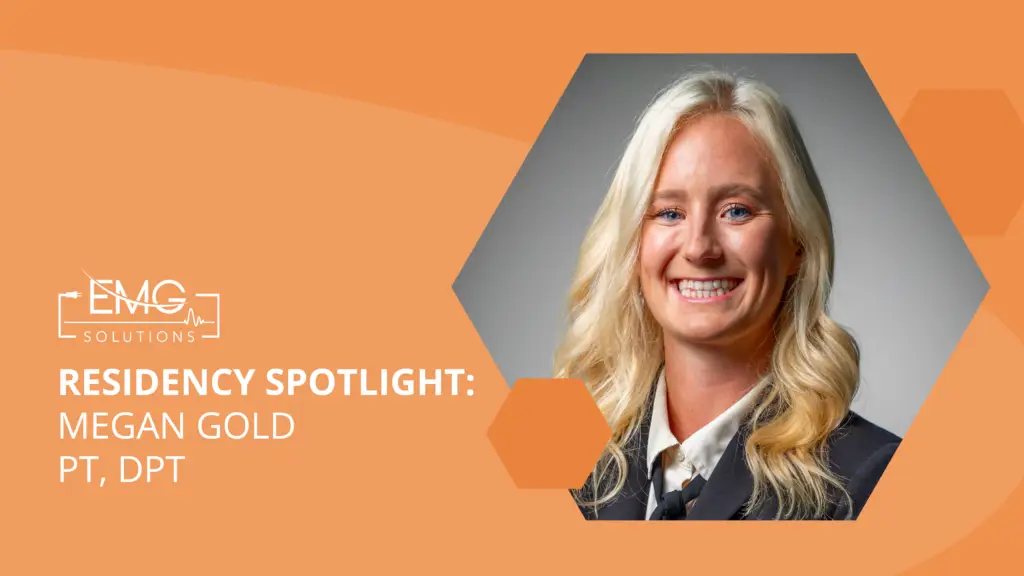
An interview with Megan Gold, PT, DPT about her clinical electrophysiology residency with EMG Solutions and all that she has learned.
Where did you receive your DPT degree, and what led you to the PT profession?
I received my Doctor of Physical Therapy degree from Rocky Mountain University of Health Professions in Provo, Utah. I was drawn to the field of physical therapy because it combines science, problem-solving, and human connection. I’ve always been fascinated by how movement and the nervous system work together, and physical therapy allows me to help people regain function and independence through evidence-based care. I’m especially motivated by the opportunity to empower patients—guiding them from a place of uncertainty or limitation toward confidence and improved quality of life.
When did you first learn about clinical electrophysiology offered as a specialty for Physical Therapists, and at what point did you decide EMG was the direction you wanted to take your career?
Two years ago, during the start of my physical therapy education, I was introduced to electrodiagnostic testing by Dr. Richard Nielsen, a guest lecturer, clinical electrophysiologist, and the President and Founder of Rocky Mountain University. His passion for this specialty immediately captured my attention. At that time, I had never heard of EDX testing, and after doing some research, I realized how complex and intricate it was—almost like an unsolved puzzle. That challenge intrigued me. I reached out to Dr. Nielsen and accepted his invitation to shadow him, which became a turning point in my career.
Over the next 16 months, I immersed myself in EDX under his mentorship—studying neurophysiology, refining my clinical examination skills, and gaining a deep appreciation for the problem-solving and critical thinking required in this field. My exposure continued during a 12-week clinical rotation with EMG Solutions, where I practiced electrodiagnostic testing, interpreted electrophysiology assessments, and integrated those findings into treatment plans. These experiences helped me see how EDX provides objective, meaningful data that connects symptoms to solutions for patients with neuromuscular conditions. It was during this time that I knew this was the direction I wanted to take my career.
What made you decide to go the Residency route vs. independently completing study and earning mentor hours?
I chose to pursue a residency because I value structured mentorship, guided growth, and the opportunity to be immersed in a rigorous, collaborative learning environment. While self-directed study is possible, I believe that formal residency training offers the highest standard of professional and clinical development, especially in a complex and detail-oriented specialty like clinical electrophysiology.
Through residency, I can learn directly from experienced clinicians, receive consistent feedback, and refine my technical and analytical skills in a setting designed for growth. I wanted to develop competence, and I knew that structured residency training would give me the foundation, accountability, and mentorship to achieve that.
What have you loved most about the residency?
What I’ve loved most about the residency is the variety of patients I get to see every day. Each case presents a unique challenge that pushes me to problem-solve and think critically, which keeps my work both engaging and rewarding. I really enjoy being part of a healthcare team—collaborating with other professionals to provide the best possible care and answers for patients who are often seeking clarity and hope.
Beyond the technical side, I’ve loved the human connection that comes with this role. Being able to sit one-on-one with patients, share meaningful conversations, and see their relief or gratitude when they finally have answers is incredibly fulfilling. This experience has reinforced why I chose this profession in the first place—to serve others and make a genuine difference in their lives.
Is there anything you have disliked about the residency?
If I had to identify one thing I’ve disliked, it would be being away from my family. The residency opportunity is in the southeastern region, and while that distance has been challenging at times, the experience itself was too valuable to turn down.
Being away from home has pushed me to grow both personally and professionally. It’s helped me become more independent, adaptable, and focused on achieving my long-term goals. I’ve learned to build new connections and create a strong support network within my professional community, which has made the transition easier. While the distance has been difficult, I’m thankful for the opportunity to grow through this experience and to pursue training that truly advances my career and skill set.
What is the most interesting case you have tested so far, and what did you learn?
One of the most interesting cases I have tested was during my clinical rotation, when I assisted my now colleague in evaluating a patient with a lumbar plexopathy. The patient was a woman in her mid-30s who had a history of ovarian and uterine cancer requiring both internal and external radiation treatments. As a result of the extensive cancer therapy, she developed a radiation-induced lumbar plexopathy, which manifested as difficulty lifting her hip during gait, mild foot slap, and intermittent knee buckling that required the use of a brace.
This case was particularly memorable because it highlighted how complex and multifactorial nerve pathologies can be. I learned that nerve dysfunction is not always caused by direct trauma or compression—it can also result from metabolic changes, inflammatory processes, or systemic conditions. Factors such as repetitive motion (like prolonged typing or poor ergonomic positioning), uncontrolled diabetes, traumatic injuries, chronic alcohol use, viral infections, chemotherapy, and radiation exposure can all contribute to peripheral nerve damage. Overall, this case reinforced the importance of a comprehensive patient history, critical analysis, and clinical correlation. It reminded me that as clinicians, we must always look beyond the immediate symptoms to uncover the underlying mechanisms affecting the nervous system.
What words of advice would you like to share with potential or future residents?
My advice to future residents is to remember that EMG and NCS testing are extensions of the clinical examination. We are physical therapists first, and critical thinking must remain at the core of what we do every day. Developing a deep understanding of anatomy, especially the brachial and lumbar plexuses and nerve-to-muscle innervation, will make you a stronger clinician, not only in clinical electrophysiology but in any area of practice.
Ellen Johnson Sirleaf once said, “The size of your dreams must always exceed your current capacity to achieve them. If your dreams do not scare you, they are not big enough.” In the short term, the fascination of clinical electrophysiology has shaped my career goals, and I am committed to consistent excellence both clinically and academically. I would encourage future residents to pursue this specialty with that same mindset—embracing the challenge, trusting the process, and striving for excellence even when the path feels daunting.
Has the residency met your expectations? How?
Yes, the residency has absolutely met my expectations. I’ve received exceptional mentorship from my colleagues, and the didactic coursework combined with the onsite clinical training has been invaluable in deepening my understanding of pathology and refining my hands-on testing skills. The small, supportive nature of our team fosters open communication, individualized feedback, and a collaborative learning environment. I truly feel that this program has elevated both my clinical reasoning and technical proficiency.
If you previously completed a clinical rotation in the EMG field, what benefits did you discover, if any, before deciding to join the residency?
During my 12-week clinical rotation with EMG Solutions, I gained firsthand exposure to the real-world application of electrodiagnostic testing. I learned how to integrate clinical examination findings with EMG and NCS results to form comprehensive, evidence-based assessments. That experience strengthened my appreciation for how electrophysiological data can clarify diagnoses, guide treatment planning, and ultimately improve patient outcomes. It also confirmed my desire to pursue this specialty further through residency training, where I could continue developing those skills under structured mentorship.
Is there anything else you would like to share with potential residents or those considering the EMG Solutions Residency?
I would encourage anyone considering the EMG Solutions Residency to embrace the challenge and trust the process. This program offers an incredible opportunity to grow in a highly specialized field while working alongside knowledgeable and supportive mentors. It’s a journey that demands precision, curiosity, and persistence—but the reward is the ability to make a meaningful difference for patients who often come to us seeking clarity and answers. If you have a passion for neuroanatomy, problem-solving, and lifelong learning, this residency will be an immensely fulfilling experience.
This blog is a feature from Edition 8 of our newsletter, which you can find here. Visit our Clinical Electrophysiology Residency Program to learn if this is the right step for you.